In this lesson, you’ll learn:
- How to tell how fast music should be played — and why that matters
- How beats are grouped using time signatures, bars, and barlines
Clear, steady rhythm is the backbone of any good performance — and you’re about to learn how to read it like a pro.
The pulse (or beat) is like the heartbeat of music — it keeps everything moving.
When writing music, there are two key things to show:
- Speed – how fast the music goes
- Grouping – how the beats are organized into bars
These help performers stay in time and understand the rhythm clearly.
Decision 1. The speed (otherwise known as tempo)
The tempo — or speed — tells you how fast the music should be played.
The tempo — or speed — of a piece of music plays a big role in how it feels and what style it fits into. Some genres have typical tempos: for example, romantic ballads are usually slow, while disco tracks are fast and energetic. Tempo helps set the mood and shape the overall vibe of the music.
In traditional sheet music, the speed of a piece — called the tempo — is shown using an Italian word, like the examples below.
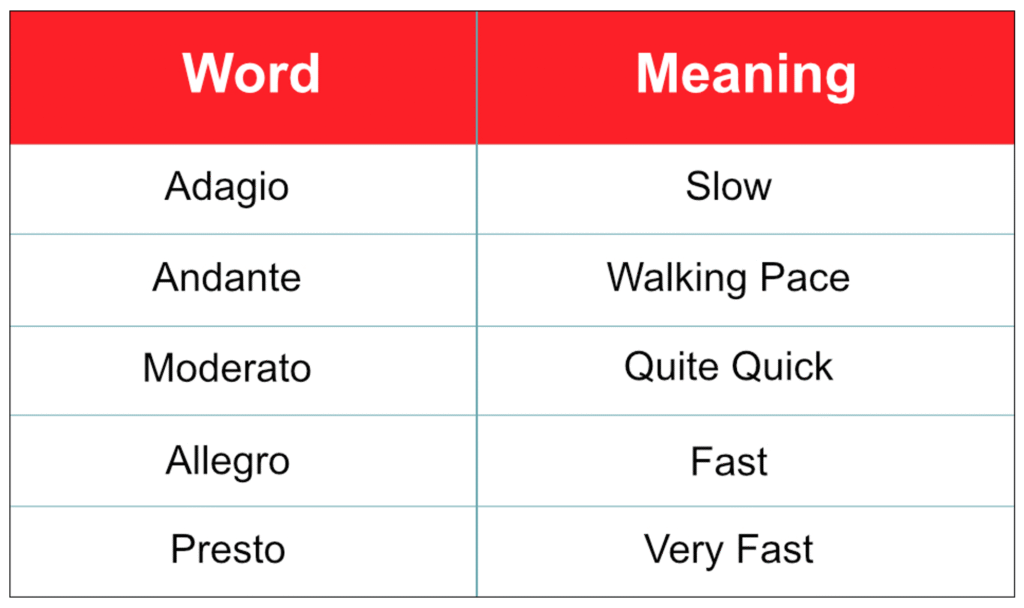
These words appear above the staff and are called tempo markings. They tell the performer how fast or slow to play. For example, if the marking says “Adagio,” the music should be played slowly.

In recent years, the tempo of a piece is more commonly indicated using BPM (beats per minute). You might see it represented like this…

This means the quarter note (crotchet) pulse of the piece is set at 60 beats per minute (BPM)—in other words, there are 60 crotchet beats in one minute. This is known as a metronome marking, though the same principle can be applied using different note values, such as quavers or semiquavers.
Small variations in tempo add expression and energy to a piece. Accelerando (accel.) indicates a gradual increase in speed, while rallentando (rall.) and ritardando (rit.) signal a slowdown. After one of these changes, the phrase a tempo is used to instruct the performer to return to the original pace.
The grouping of the beat.
If we counted every beat from start to finish in a piece of music, we’d quickly lose track — and the music would lose its rhythm and feel.
Instead, musicians group beats into small sets, usually 3 or 4 at a time. This makes the music easier to follow and gives it a clear groove. For example, a waltz feels different from a march because the beats are grouped differently — and that grouping shapes the whole character of the music.
If you were learing to march, you’d probably count “1-2-3-4” to help you step in time — then start back at “1” again. It just feels natural to group the beats like that.
If we were learning to waltz, we’d count “1-2-3” and repeat — because that fits the rhythm of the steps.
Music works the same way. Beats are grouped into bars, and the first beat of each bar is usually played a little stronger to give the music its feel or groove. Different groupings create different styles and moods.
Let’s give it a go…
Say the following “ch” sounds out loud to a steady beat. Make the bold ones louder:
ch – ch – ch – ch ch – ch – ch – ch
Hear that steady, marching rhythm?
Now try this pattern:
ch – ch – ch ch – ch – ch ch – ch – ch
Feel the difference? Grouping the sounds in threes gives it a flowing, waltz-like feel instead. That’s how beat groupings shape the groove of music.
To put this into sheet music we need two things. Time Signatures and Bar lines.
Counting the beat
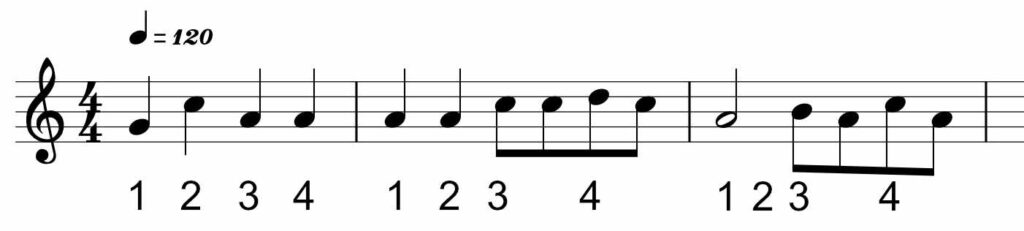
In 4/4 time we count “1, 2, 3, 4” repeatedly for each measure, keeping a steady pulse.
The steady pulse of 4/4 time makes it one of the most common time signatures in music. It’s widely used in pop, rock, jazz, and classical compositions.
What is rhythm?
Duration (noun) = the length of time something continues or exists
We’ve covered how to determine a note’s pitch, but we haven’t yet looked at its length. The time a note is held is called its duration. In this chapter, we’ll learn how to recognize a note’s duration simply by analyzing its visual characteristics.
- How to read and clap different rhythms
Triplets and Rests
Rhythm (noun) = the movement with uniform or patterned recurrence of a beat, accent or the like.
As you can see from the definition above, rhythm is challenging to describe with words alone. It is an aspect of sheet music that must be learned through practice—by hearing and playing it. In this chapter, we will focus on experiencing rhythm firsthand.
To master this, it’s essential to practice the following exercises out loud. Rhythm is something that must be heard and felt, not just read on a page.
Start tapping the beat with your foot….
Now weʼre going to clap some rhythms with our hands.
Clap quarter notes (crotchets) – these will occur on every beat. Beats are marked with a “>“ in the following examples.
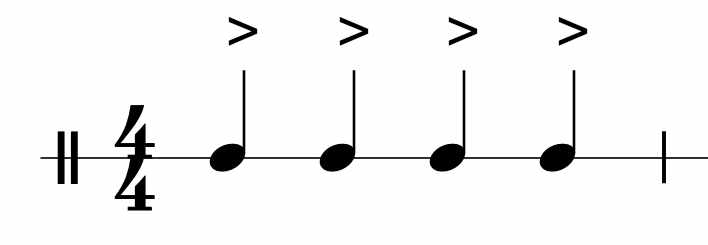
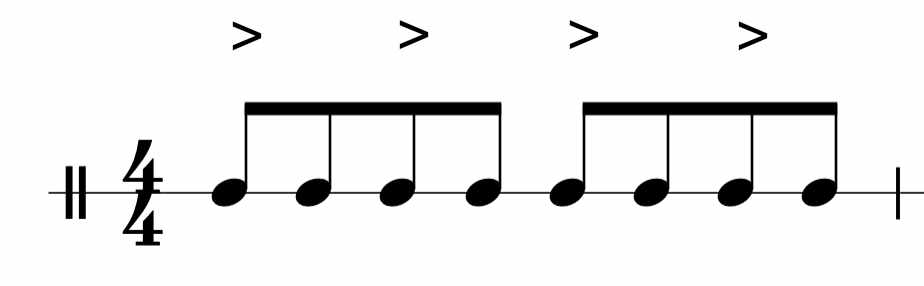
“Increase the clap frequency by playing 8th notes (quavers), landing on every half‑beat.”
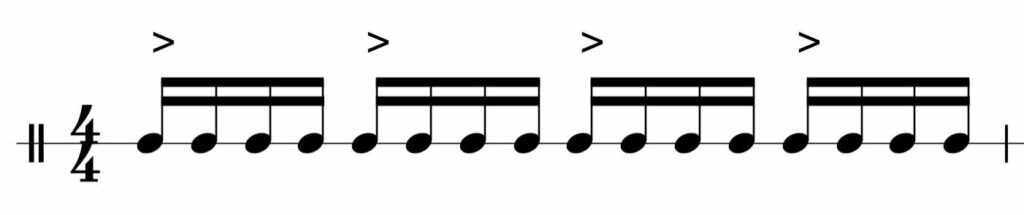
Increase the clap frequency further by playing 16th notes (semiquavers), striking on every quarter‑beat.
Attempt clapping in 32nd notes (demisemiquavers), striking on every eighth subdivision of the beat—they’re very quick!

Now reduce the clap frequency and return to the quarter‑note (crotchet) pulse.
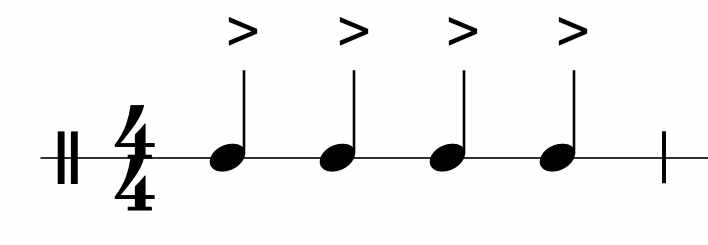
Slow down the clapping to half notes (minims), striking on every other beat.
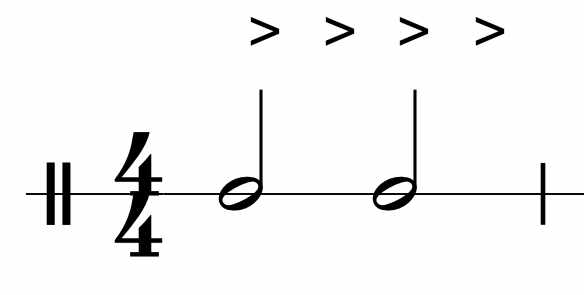
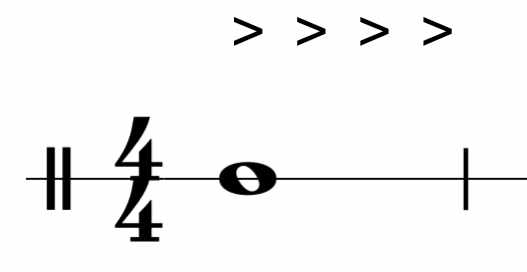
Reduce the clap frequency again: clap semibreves (whole notes), landing just once per bar on beat one.
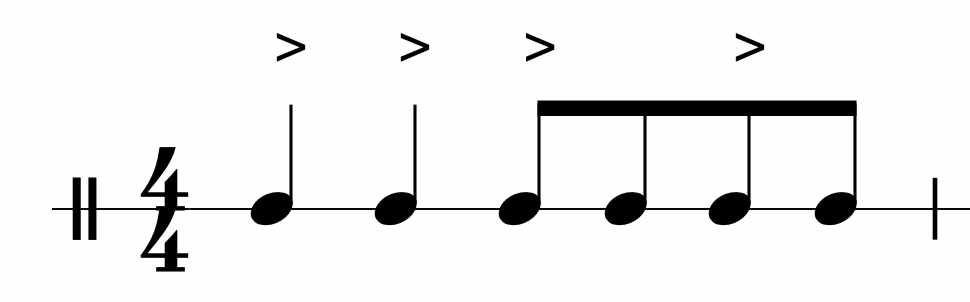
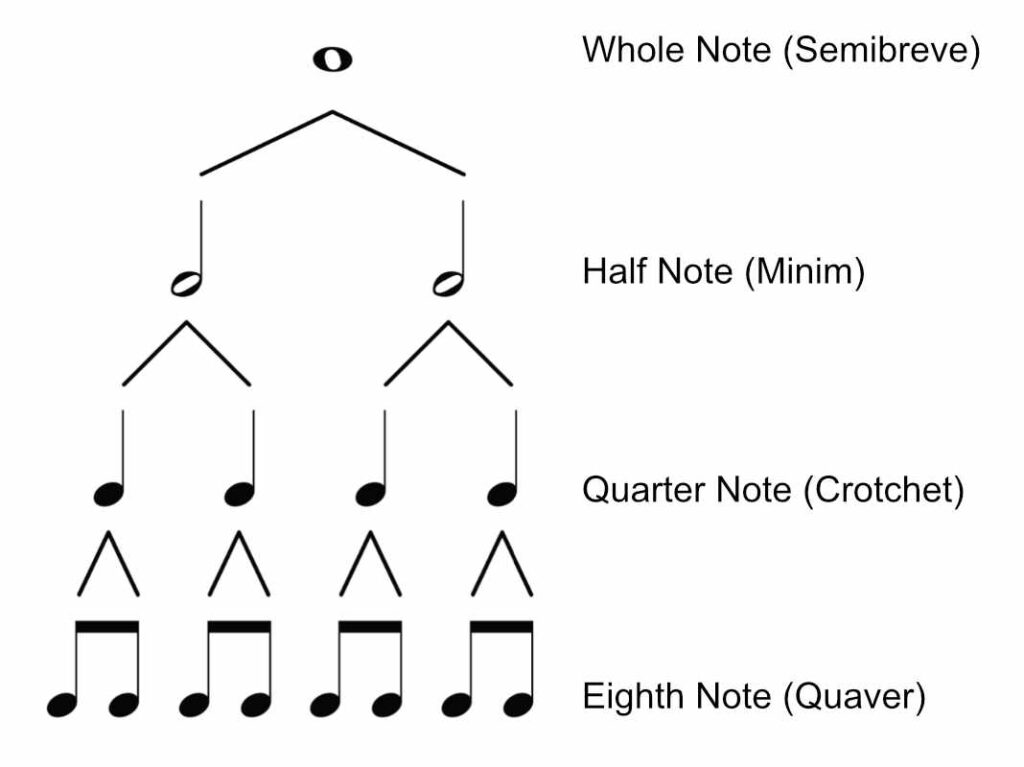
We can mix note values together: for example, 2 quarter notes (crotchets), each worth 1 beat, alongside 4 eighth notes (quavers), each worth half a beat, all within the same bar.
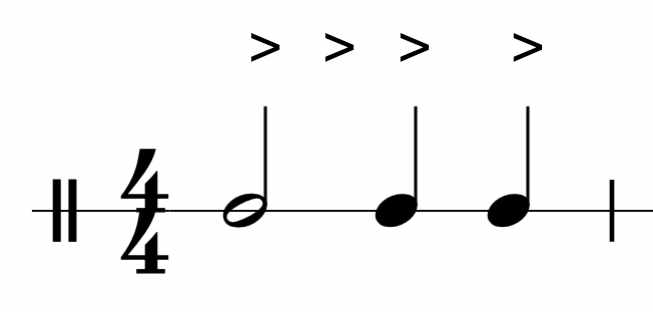
Now let’s combine 1 half note (minim), worth 2 beats, with 2 quarter notes (crotchets), each worth 1 beat, all within the same bar.
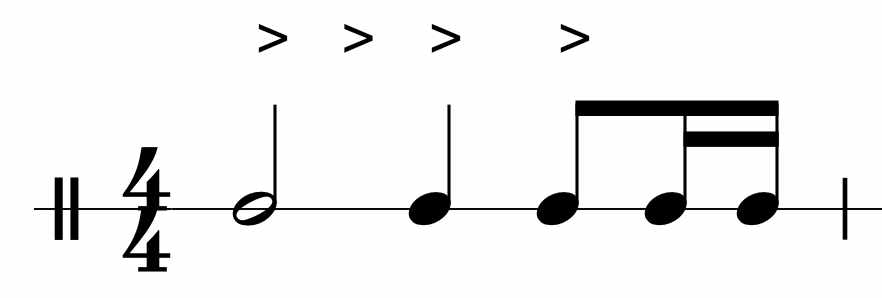
Now let’s combine a half note (minim, 2 beats), a quarter note (crotchet, 1 beat), a quaver (½ beat), and two semiquavers (16th notes, ¼ beat each) within the same bar.
Time Signatures
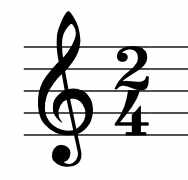
The top number represents how many notes, and the bottom is the type of note.
4 is the code name for a crotchet or quarter note. 4/4 tells us that there are 4 crotchets per bar.
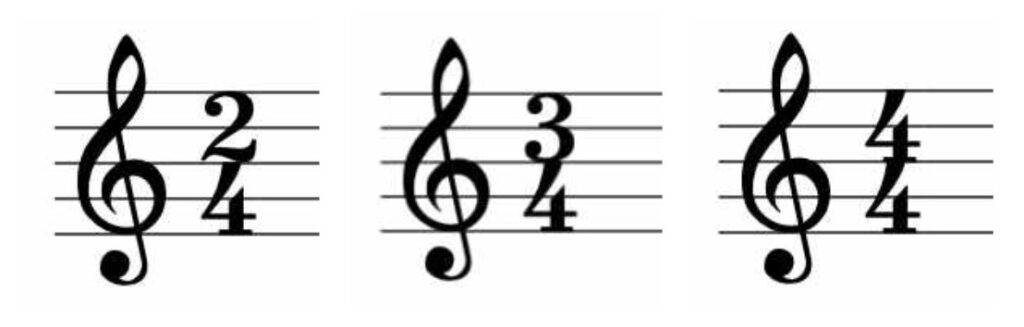
Here is a time signature where each ¼ note (crotchet) gets one beat of the bar.
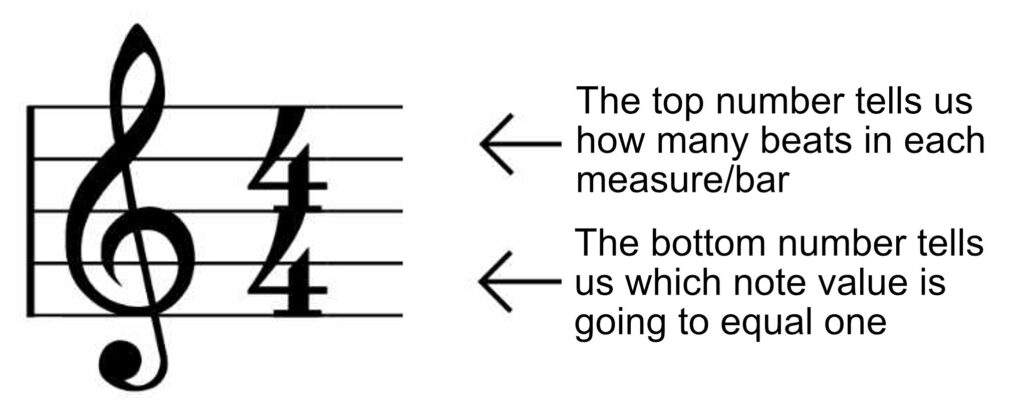
The upper 4 tells us that there are four beats in each bar, and the bottom number tells us each beat lasts for the length of a ¼ note (crotchet). 4/8 means an 8th note (quaver) is equal to one. 4/2
The number most often found at the bottom of a time signature is 4, which indicates that each beat is a quarter note (crotchet). In the example above, the time signature shows that every bar contains four quarter-note beats, meaning the total value of each bar must add up to four.
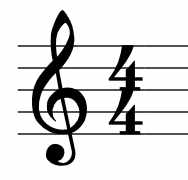
If the bottom number is 2, this indicates that each beat is a half note (minim). In this case, the time signature shows that every bar contains four half-note beats. Since each half note is worth 2 counts, the total value of the bar must equal 8 (4 × 2).
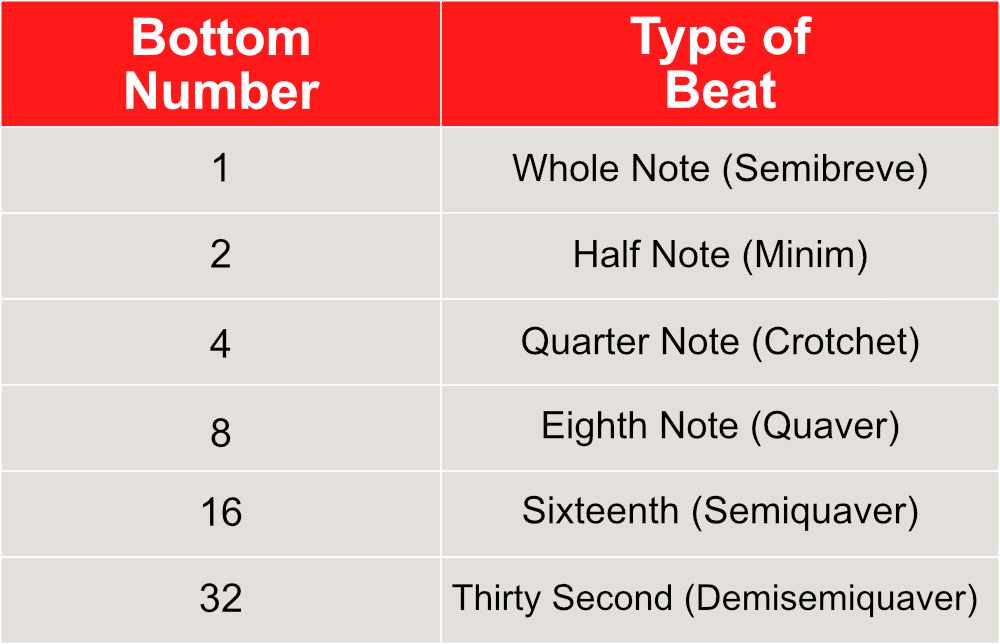
The list below shows the type of beat indicated by the bottom number in a time signature.
To recap:
- Time signatures go at the top left at the start of the music unless we change time signatures later.
- Time signatures tell us how many beats per bar we have, and which note represents the beat.
- The bar lines divide up our bars.
- Bars in the UK and Measures in the US. Mean the same thing.
- DAW’s (Ableton, ProTools) refer to measures.
Bar Lines
Barlines show us where the groupings are divided.
4/4 time
ch ch ch ch | ch ch ch ch |

3/4 time
ch ch ch | ch ch ch |

Note lengths/Duration
Duration means how long something lasts — in music, it’s how long you hold a note.
We’ve learned how to find the pitch of a note, but now we need to know how long to play it. A note’s duration tells us that, and you can figure it out just by looking at the shape of the note.
There are two ways to describe note lengths:
- The modern way uses divisions like quarter notes
- The traditional way uses names like crotchets
You’ll see both, so I’ll use the modern term first, followed by the traditional one in brackets — like quarter note (crotchet).
To figure out how long a note lasts in sheet music, just look at its shape and ask:
- Is the notehead solid or hollow?
- Does it have a stem?
- Is there a tail (or flag) on the stem?
Note lengths/Duration
Duration means how long something lasts — in music, it’s how long you hold a note.
We’ve learned how to find the pitch of a note, but now we need to know how long to play it. A note’s duration tells us that, and you can figure it out just by looking at the shape of the note.
There are two ways to describe note lengths:
- The modern way uses divisions like quarter notes
- The traditional way uses names like crotchets
You’ll see both, so I’ll use the modern term first, followed by the traditional one in brackets — like quarter note (crotchet).
To figure out how long a note lasts in sheet music, just look at its shape and ask:
- Is the notehead solid or hollow?
- Does it have a stem?
- Is there a tail (or flag) on the stem?
These clues help you understand the note’s duration at a glance.
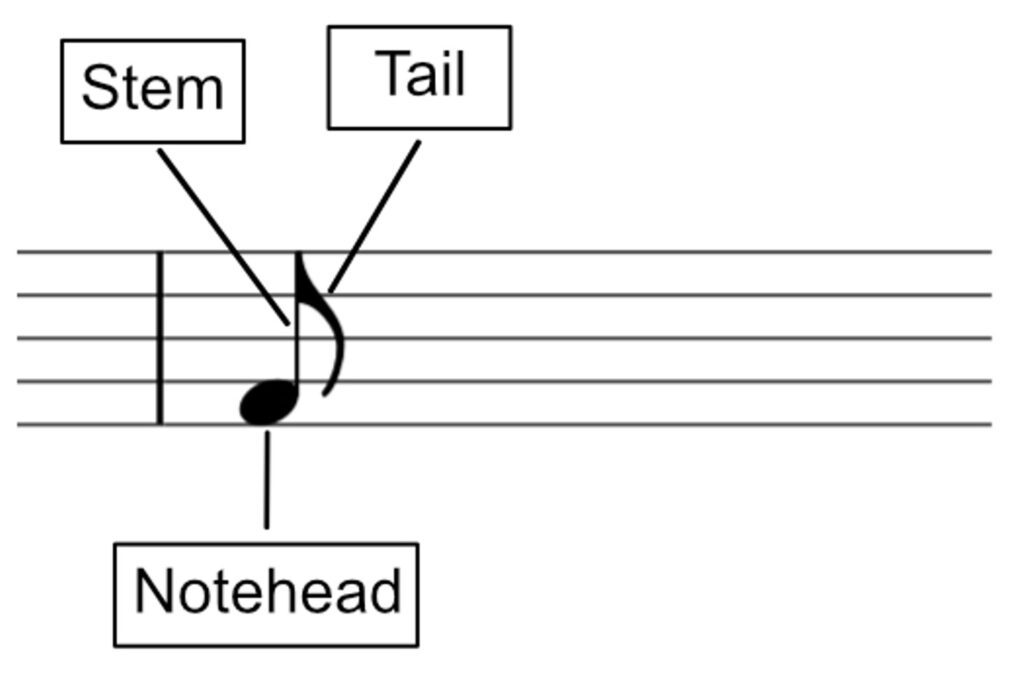
An 1/8 note (Quaver)
Each quaver (1/4 note) is a fully blacked out note head with a straight stem and “a tail”.
(In 4/4 it will be 1/2 beat)
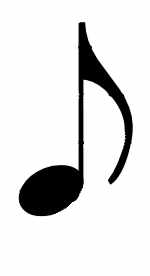
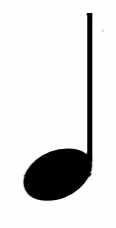
1/4 note (Crotchet)
Each crotchet (1/4 note) is a fully blacked out note head with a straight stem.
(In 4/4 it will be 1 beat)
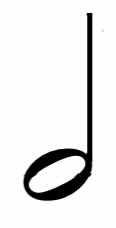
1/2 note (Minim)
A minim (half-note) lasts twice as long as a crotchet. Looks like a crotchet but the note head isn’t filled in.
(In 4/4 it will be 2 beats instead of one beat.)
Whole-note (Semibreve)
A semibreve (whole-note) lasts twice as long as a minim. Looks like a minim with no stem.
(In 4/4 it will be 2 beats instead of one beat.)

The note value tree
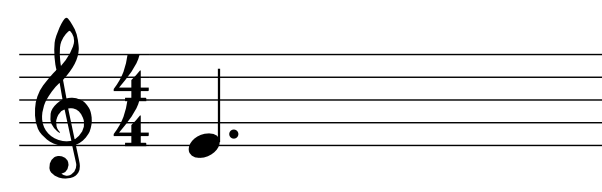
Sometimes, you’ll see a dot placed after a note—but don’t confuse this with a dot above or below the note, which has a different meaning (we’ll cover this later). A dot after a note increases its duration by 50%.
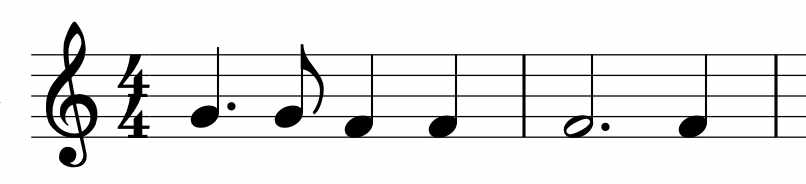
For example, a dotted quarter note (crotchet), which is normally worth 1 beat, will now last 1 and a half beats (1 plus an extra half).
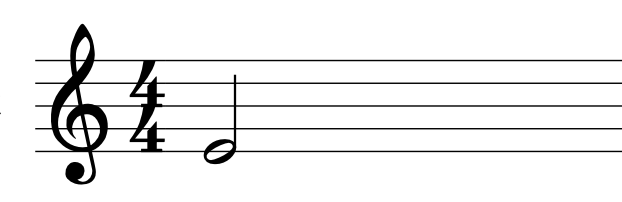
If a dot is put after a half note (minim) (normally worth 2 beats) then it will now be worth 3 beats (2 plus 1).
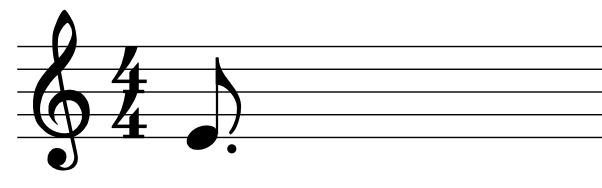
If a dot is put after an eighth note (quaver) (normally worth half a beat) then it will now be worth three quarters of a beat (half plus a quarter).
Just as every note length has a corresponding symbol, there are specific symbols that indicate silence in music. These are known as rests.
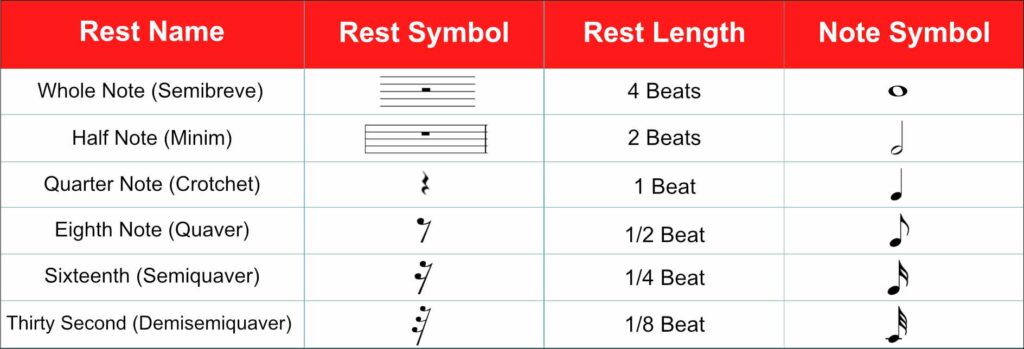
This means that we can combine notes and rests into the same bar. Letʼs take a simple example, a combination of quarter notes (crotchets) and quarter note rests….
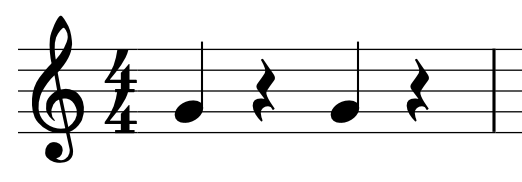
We can make it more complex by combining different rests….
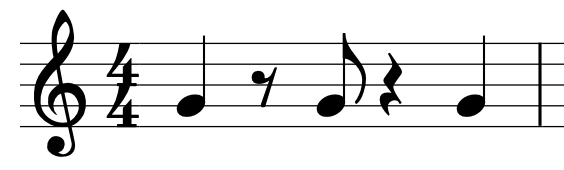
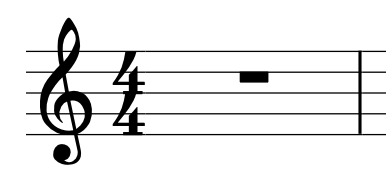
If an instrument should not play for a bar then it will be written as follows….
Triplets:
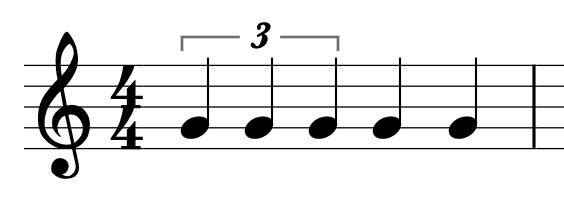
Most beat divisions in music follow powers of two—like ½, ¼, ⅛, and so on. These are technically called duplets. When a beat is split into three equal parts instead, it’s marked as a triplet. To show this, a small “3” is placed above the group of notes, indicating that three notes should be played in the space where you’d normally find just two. So in this example the “3” over the top of the quarter notes (crotchets) means that 3 crotchets adds up to 2 beats instead of 3.
What about ties?
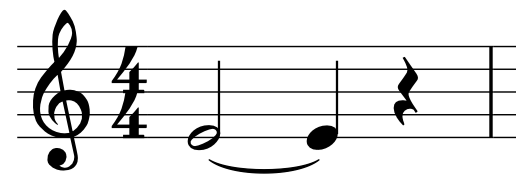
A tie in music notation is a curved line that connects two notes of the same pitch, indicating that they should be played as a single note with a duration equal to the combined value of the individual notes.
The example below means that the two crotches (quarter note) are played together hence are equal to a half note (minim).
The tied notes should be held for 2 beats
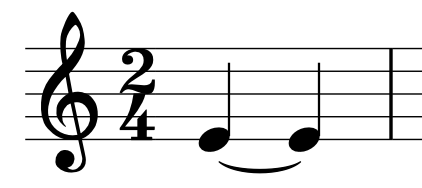
The marking for ties and slurs is identical and can be confusing. The difference is a tie connects two notes of the same pitch (on the same line or space of the staff).
The tied notes should be held for 3 beats