Some scale theory-Understanding Steps in Music.
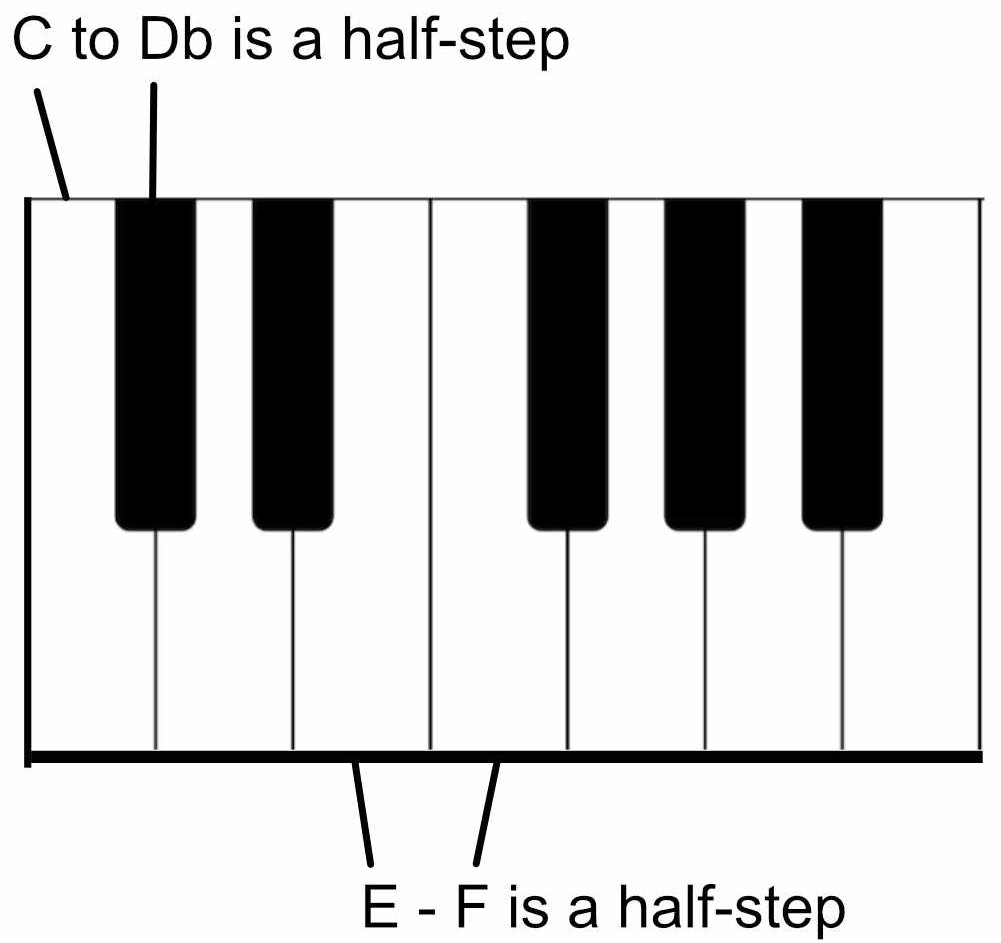
A half step means moving one note to the next closest key.
-C to Db is a half-step as it is moving to the next possible key. Db is the black key just to the right of C and the left of the two black notes.
-E to F is also a half step as its the next possible note.
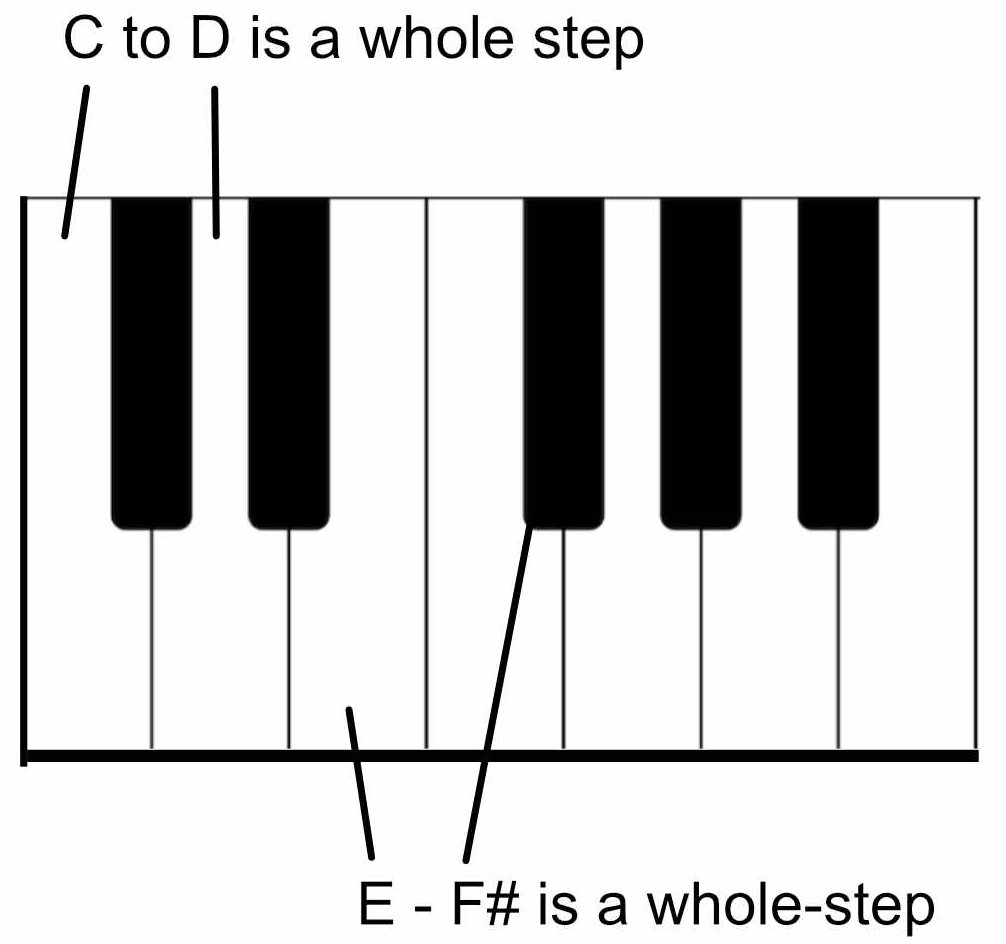
A whole step is made up of two half steps
– From C to D is a whole step
– From E to F# is also a whole step.
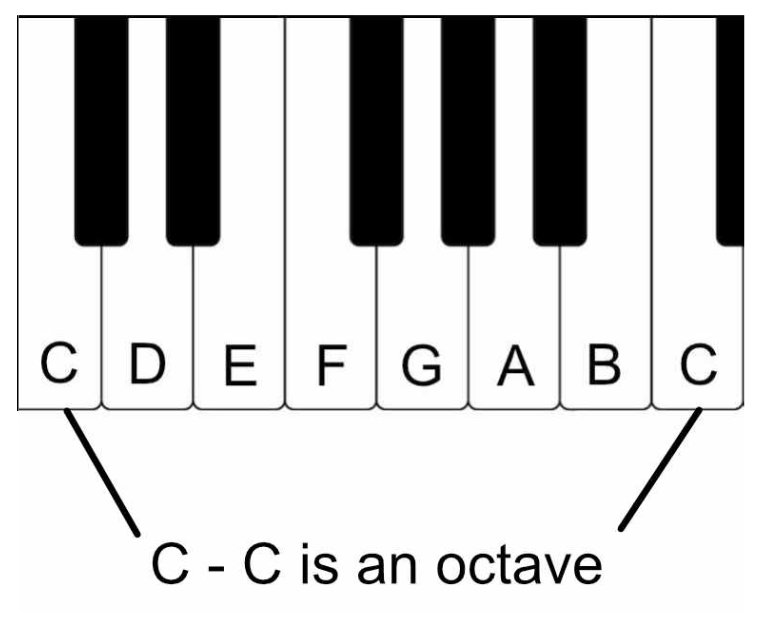
C to the C above or below is an Octave
The Major Scale Formula
Every major scale follows the same pattern:
Whole, Whole, Half, Whole, Whole, Whole, Half
(Tone, Tone, Semitone, Tone, Tone, Tone, Semitone)
That means once you learn this pattern, you can build a major scale in any key by following this pattern of steps.
You can start on the first note then you can easily work out the rest of the scale.
Here is the C major Scale half steps and whole steps.
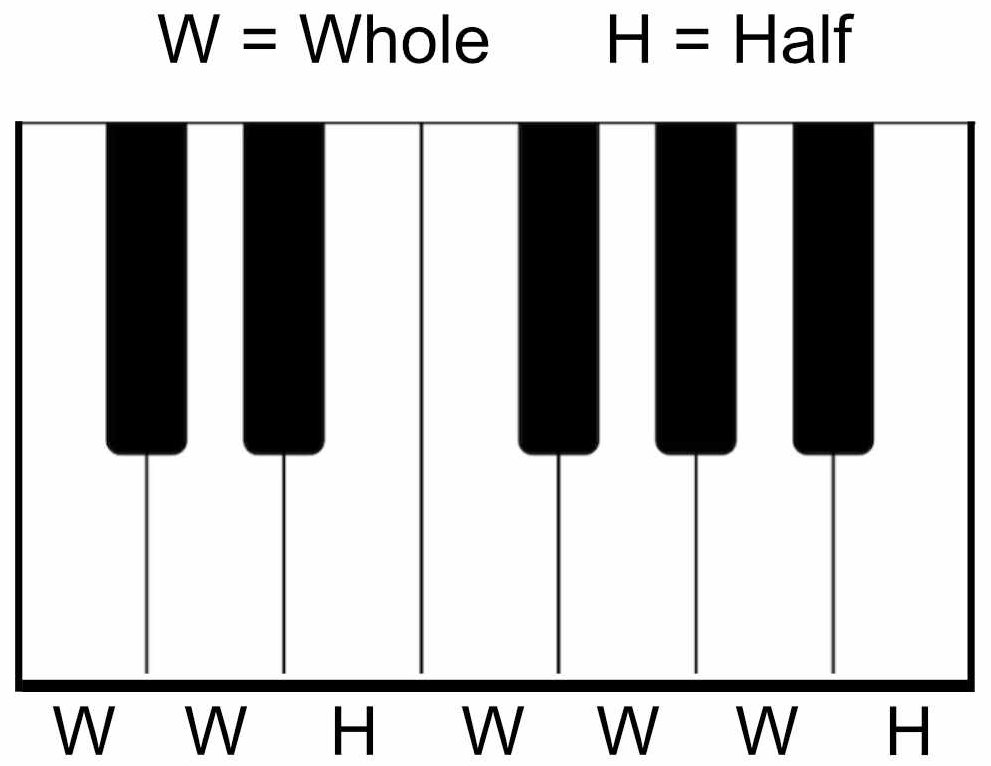
Try this formula to the G major scale but don’t worry about the G major scale too much for now:
- Start on G
- Whole step (tone) → A
- Whole step (tone) → B
- Half step (semitone) → C
- Whole step (tone) → D
- Whole step (tone) → E
- Whole step (tone) → F#
- Half step (semitone) → G
C major Scale
Scales are essential.
- Helps you physically and makes your hands loose and limber. Warms you up and protects you from injury.
- Help muscle control and helps you with your touch and expression.
- Helps you mentally with understanding music theory, as both melodies and chords are built from scales.
- Show C major scale.
- Play 2 octaves.
- Name notes as we play.
- Name the fingers.
Each time we reach the crossover point between the E-F going up the scale you put your thumb under the third finger and coming down you put your third finger under your thumb.
(legato-smoothly)
A lot of piano music requires that smooth legato sound which means organising our fingers well to play all the notes we must play without too much jumping.
We are aiming for evenness, smoothness and accuracy.
Practise the C major scale. Try to avoid an audible break or unevenness when you have fingers over or under each other.
It’s easy to land a bit hard on your thumb when your thumb goes under your third finger.
This can be tricky.
Scales may seem pointless but getting scales good makes the difference between a slick fluent musical piano player or one that is jumping and jolting.
C scale is 8 notes (technically 7 as we repeat C)
Right Hand
- Place right hand on keyboard with 1st finger on Middle C and other fingers on notes above as the five finger scale.
- This time play C,D,E. Keep 3rd finger on E then the thumb comes underneath then your whole hand comes round and resets.
- To come back down keep thumb on F then third finger comes over onto E.
Left Hand
- Finger 5 on C below middle C.
- Keep thumb on G then third finger over onto A.
- Descending, keep 3rd finger on A then tuck thumb under.
- Practice each hand 5 times. When you are confident bring in the metronome. 50-60bpm
When you are comfortable with C you can move onto other scales.
Metronome Exercise.
- Start by setting the metronome to 50 bpm and get your hands ready.
- Play a C major scale, placing one note on each beat.
- If the tempo feels too fast, adjust down to 40 bpm until it feels comfortable.
- Once you’re confident, gradually increase the speed by 2–3 bpm at a time.
- Do this twice with your right hand, twice with your left hand, then twice both hands
This skill is going to help you down the road. Once you get the hang of it, you’ll fall into a natural rhythm, and everything will start to feel smooth and effortless.
It’s all about consistency—stick with it, and you’ll build solid timing that makes playing feel way more natural.
Beat or pulse
Before understanding note lengths, you must understand beat.
The beat is the steady pulse that runs through almost every song. Most music has a consistent beat that stays the same speed, but it can also speed up, slow down, or even pause.
We usually group beats into sets of 2, 3, or 4, which are called bars or measures. When counting beats, we talk about beats per bar—like 2 beats per bar, 3 beats per bar, or 4 beats per bar. These beat patterns help shape the rhythm and feel of the music.