Ledger Lines and Black Notes
Ledger Lines
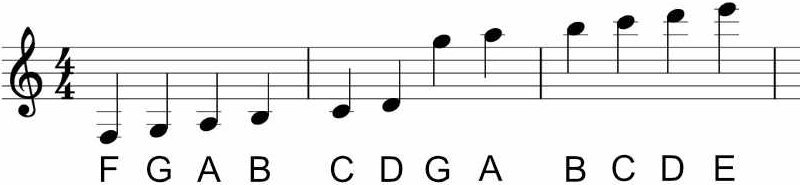
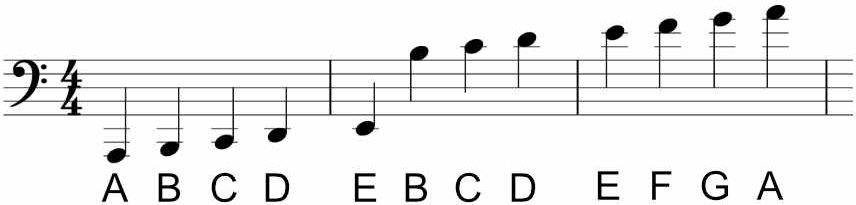
To represent the notes outside the stave that are close we use ledger lines. These are
more lines for the stave, but they are only written in when needed.
What about the black notes?
Take a look at the keyboard below—you already know that a set of eight white notes is called an octave. But when we include the black notes, the full pattern expands to 12 notes in total.
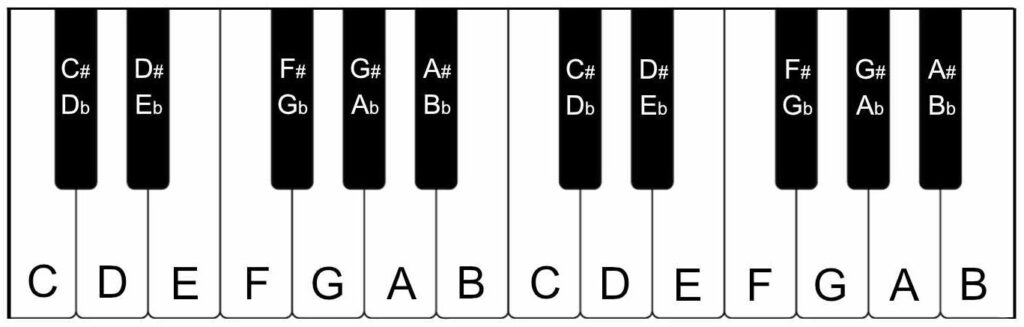
You will notice that the black keys have two names. These are notes that sound the same but two have different names. These are call Enharmonic equivalents.
For example, C# and Db are the same key on the piano—they just have different names depending on how the music is written. This happens with all sharps and flats. While you don’t need to know this to read sheet music, it’s good to know.
We now know the white notes (otherwise known as the naturals) on a piano/ keyboard. However, we need to also know when to play the black notes. To understand the black notes, we need to grasp the concept of semitones (halfsteps).
Sharps (#) raise the note by a semitone (half step), whilst flats (b) lower the note by a semitone (half step),. They are shown by a # sign or a b sign placed BEFORE the note.
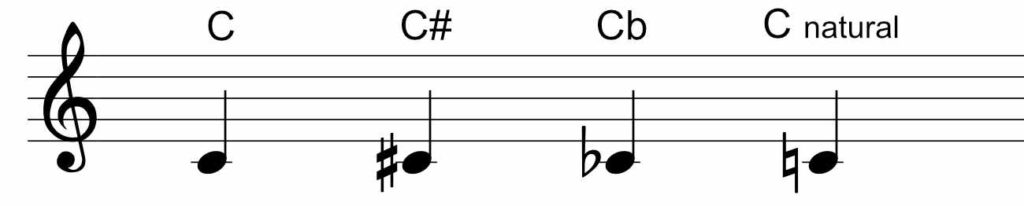
Grand staff with treble clef and crotchets/quarter notes showing C

Grand staff with treble clef and crotchets/quarter notes showing G
Enharmonic Equivalents
An enharmonic equivalent refers to two notes that sound the same but are written differently — like C♯ and D♭. It’s a fun musical quirk, not essential for reading sheet music.
Double Sharps and Double Flats:
Occasionally in sheet music, you’ll see a symbol like “x” before a note — this is a double sharp, and it tells the musician to raise the pitch by two semitones (or one whole tone). On the flip side, the “♭♭” symbol is a double flat, which means the note should be lowered by two semitones.
Think of it as a musical nudge — either two steps up or two steps down the keyboard.
“8ve” Signs
When you spot an “8ve” symbol placed above a group of notes it means those notes should be played one octave higher than they appear on the staff. It’s a shorthand musicians use to avoid cluttering the page with extra ledger lines.