mrkeyboarddave.com

Welcome to the course.

Whether you’re a complete beginner or looking to refine your skills, this course will guide you step by step through the essentials of playing the keyboard, helping you build confidence, technique, and musical understanding.

This isn’t just about pressing keys—it’s about unlocking your creativity and developing a lifelong love for music. By the end of this course, you’ll have the tools to play songs and understand the foundations of music theory—all in a structured yet enjoyable way.

How long to practice.

Consistent, short practice sessions are the way to go. Aim for 20–30 minutes a day (or two 15-minute sessions) 5–6 days a week. This steady approach helps you build the necessary finger strength while reducing the risk of injury. Playing the piano requires muscle development, so gradually increasing practice time ensures you’re building up the muscles you need for playing the piano.

Consider splitting practice up into two sessions. 15 minutes in the morning & 15 minutes in the afternoon.

This approach keeps your mind fresh and helps reinforce learning throughout the day.

Stay consistent, and you’ll see steady improvement!


Sitting at the keyboard.


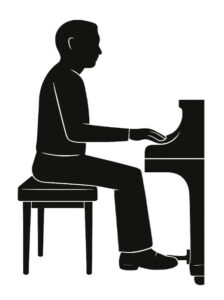
Make sure you are centred in the middle of the keyboard with your chair at the right height, your feet on floor and your back straight.
You should be able to reach all keys.


Make sure your chair is at the right height.


Keep your back straight


Arms relaxed and elbows slightly higher than the keys


Make sure your feet are flat on the floor

Hand Position

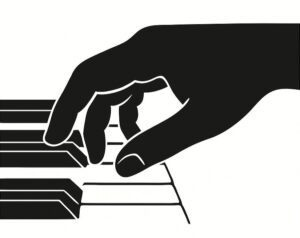
hand position

Keep your fingers gently curved and your wrist elevated.

Imagine a delicate bubble resting beneath your hand—maintaining this shape keeps it intact.

If you lower your hand too much, the bubble pops.

This will help you to preserve a relaxed and proper hand position.

Finger Numbers

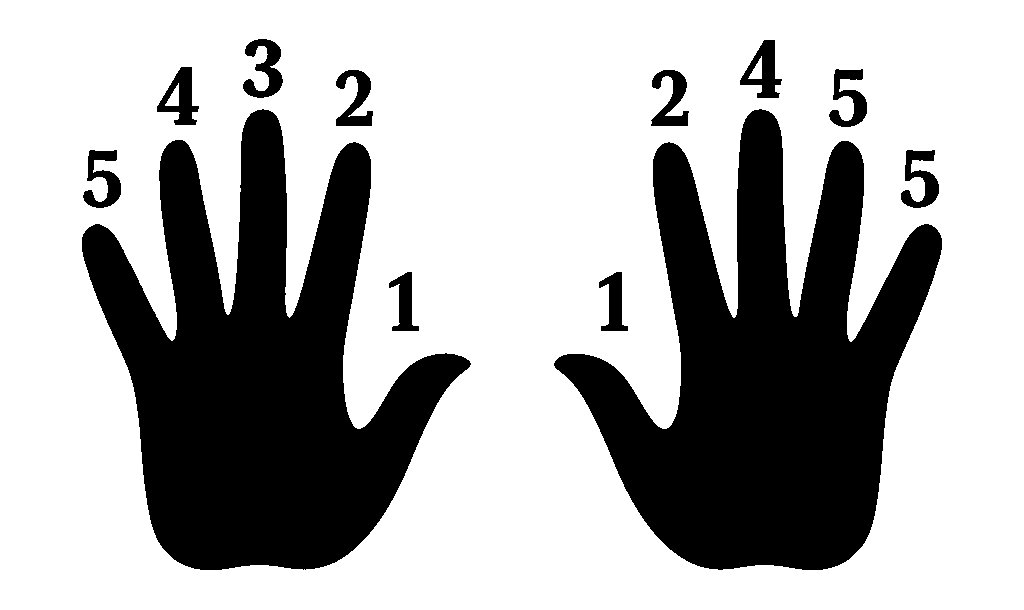
We number the fingers on our hands

Thumb finger is 1

Pointer finger is 2

Middle finger is 3

Ring finger is 4

Little finger is 5

Finger Numbers

Exercise:

Place your hand on a flat surface and lift one finger at a time naming the finger number as you do so.

Playing with a Metronome

A metronome is a great tool for keeping a steady beat while you play.
It helps you stay in time and play notes evenly at the right speed. At first, it might feel tricky because it won’t adjust to you—it just keeps going.
But the more you practice with it, the easier it gets, and you soon start to develop a  strong sense of rhythm.

If you ever play with other musicians, timing is important, but even if you’re playing alone, good rhythm makes your music sound smooth and natural.
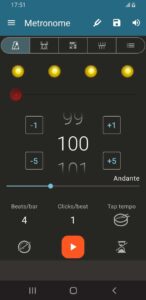
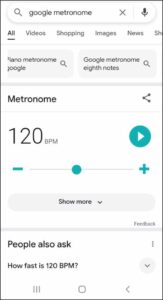
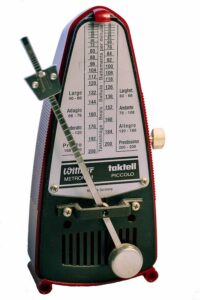
You can use Google Metronome, a free metronome app, or you can buy a real metronome.

Beats Metronome (Android)

Google Metronome

Google Metronome

Real Metronome

What is Pitch?

Pitch is how high or low a note sounds. Different instruments have different ranges—flutes are high, bass guitars are low, and pianos span both. Sheet music’s main job is to show pitch, and learning this is the first step to reading music.


The Keyboard

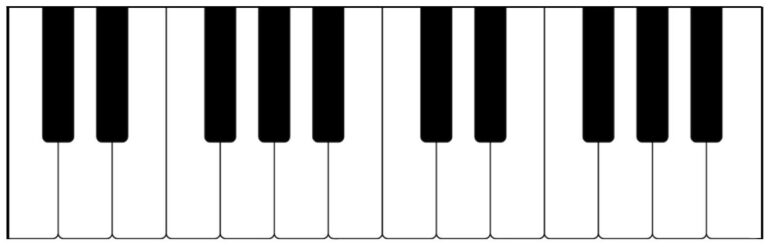
On a keyboard, there are both white and black keys. The black keys are arranged in repeating patterns: groups of two and groups of three.

We use this pattern to identify notes and navigate the keyboard.

  • With your right hand (RH), use fingers 2 and 3 to play each group of two black keys, moving from the lowest to the highest keys.
  • With your left hand (LH), use fingers 2 and 3 to play each group of two black keys, moving from the lowest to the highest keys.
  • With your right hand (RH), use fingers 2, 3, and 4 to play each group of three black keys, moving from the lowest to the highest keys.
  • With your left hand (LH), use fingers 2, 3, and 4 to play all the groups of three black keys, moving from the highest to the lowest keys.


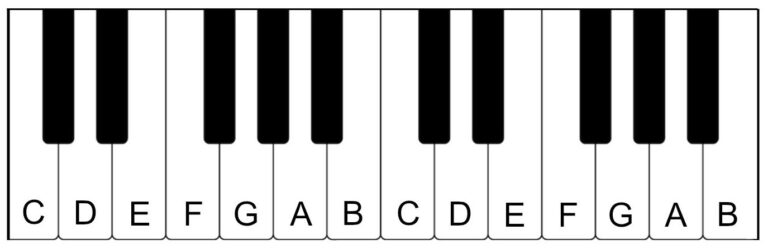
Each white (major) key has a letter attached to it.

keys-with-notes

We only use the letters A-B-C-D-E-F-G  then our musical alphabet repeats again from A.

Music is all about going through the alphabet forwards and backwards.

First, we need to find middle C. As the name suggests, it’s the C in the middle of the keyboard.  It’s the 4th C from the bottom on a full size piano.

Here is how we find middle C.

  • First, we find the group of two black notes in the centre of the keyboard.
  • Move down one note and that’s C.

Now find all groups of two and find all the C’s on the keyboard.

The next note we will find is F

  • Find the middle group of 3 black keys.
  • Move down one to F.
  • Find all the groups of three and find all the F’s on the keyboard.


C and F can be used a landmark to locate the rest of the notes.

Exercise

Get 7 small pieces of paper and write each letter of the musical scale. Place them in a bowl and when you pick one out find the note.